|
|
Review Rover P7 (MiTAC Mio558)
Standard kit:
- Handheld
- Cradle
- Charger
- Leatherette case
- CD
- User's manual
- Audio jack adapter
- USB adapter for mini USB
Before the release of Rover P7 there were no handhelds equipped with wireless adapters from Rover Computers. The appearance of such devices was just a matter of time, besides wireless technologies have been progressing greatly and step by step penetrated into Russia. Well, in addition to two slots for expansion Rover P7 is equipped with wireless adapters: Bluetooth and Wi-Fi. As well as Rover P3 and Rover P4 this handheld represents an adapted for Russia PDA from Taiwanese maker MiTAC (russification, documents, distribution and support). Both interface versions (Russian and English) coincide in functions and programs, so we won’t give a separate review on Mio558. All highs and lows as well as conclusions on Rover P7 agree with MiTAC model with minor reservations.
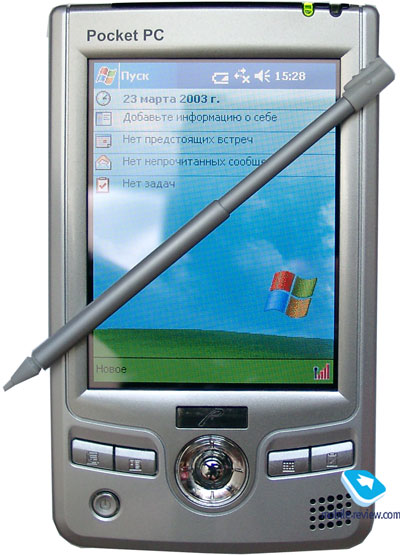
Almost a year ago [2002] data sheet and photos of the device were available, i.e. six months earlier before the release. Then the future for new wireless PDA from MiTAC looked rosy. For it combined maximum interfaces, impressive features, strict design and comparatively small dimensions. However there was a single alert factor. The company hasn’t ever dealt with wireless modules, and it was vague whether MiTAC could implement them in that very model. The handheld has debuted and proved our worries about wireless adapters. Specific implementation together with slow memory prevented Mio558 from top sales; however it became popular in certain user’s circles, they put up with some technical defects to get maximum functionality.
Forms and tests
The handheld looks strict, straight lines get a little bit rounded at edges. Some liberty is seen in the design of application keys. The casing is done in silver plastic, and screen outline seems darker. As for the plastic quality it isn’t perfect, though it is pleasant to touch and hides fingerprints. If you squeeze the device in hand it won’t creak, details properly fit each other.
With two slots for expansion the device can be called middle-sized (124x72x15 mm). Compared with latest one-slot handhelds it looks bigger, but notably smaller than Fujitsu Siemens LOOX 610, though technical features are almost the same. The device fits the hand and is easy in use mainly due to the scroll button, which appears rarely in modern PDAs (PDA makers give up the idea of mechanical elements). 170 grams weigh light in a jacket or on the belt, but not in the pocket of jeans or shirts.
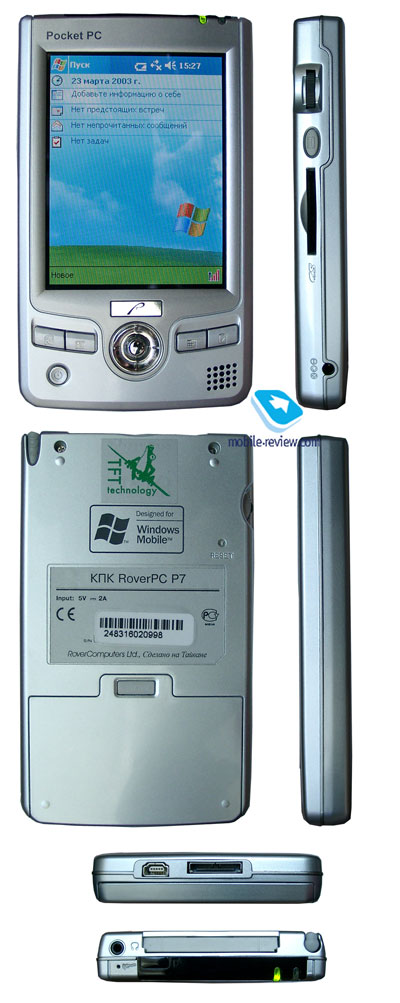
On the front side below the screen there are application keys placed horizontally (traditionally four keys stand for contacts, notes, calendar and tasks). The joystick proves to be an average one when in use. With the most applications it works correct except for games. But you get used to it in a time. On the whole the joystick reminds of that in the SX1 smartphone model from Siemens. The power button is located bottom left (a good location prevents from a casual push). There is a dynamic to the right, loud enough. It reproduces sounds of a good quality (considering a typical PDA integrated dynamics) not croaking at the maximum volume. Two LED indicators on the top display Wi-Fi activity, missed appointments and battery charging state. However they don’t reveal Bluetooth functioning.
On the left side there is the scroll button (like for Rover P3), lower appears the dictaphone button. You’d better use the dictaphone to make records within short distances and in not too loud places. Next you see the SD/MMC slot and power plug. On the top there are an integrated microphone, stereo headphone jack (the adapter for standard headphones supplied), CF slot closed with a shatter to protect from dust and a hidden IR window. The silo and the stylus remain traditional for MiTAC. The right side is free from any control elements. The soft reset button is located on the back side and the hard reset – behind the battery. At the bottom there is a plug for a cradle or synchronization cable. A peculiar feature suggests the mini USB host attached to the casing, but let’s do not hurry.
Display
What should be said about the screen? A standard one for a Pocket PC – same features, same colors. The P7 has a 3.5-inch, 65K color transflective screen: rich white colors and maximum view angle. It looks good both indoors and in direct sunlight. The minimum backlight is good for a comfort reading in the dark, but could have been less intensive. In all, there are 11 levels of backlight.
Off-line
The device comes with a swappable Li-Ion battery (1200 mAh). The manufacturer claims 10 hours of the average work not involving Bluetooth or Wi-Fi. The tests revealed only 5-6 hours of work using different functions, including radio-functions. The result could have been better considering the capacity of the battery.
Productivity
This model has standard 64 MB of RAM, 63 MB of which is available to the user. In addition, the P7 includes a 35 MB file store to back up data and install small-sized applications. The handheld is powered by Intel XScale PXA263 processor (400 MHz).
We used the SPB Benchmark package to test the productivity. For this purpose we’ve chosen models with Wi-Fi modules.
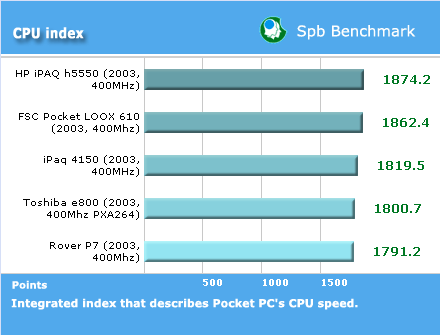
This index describes Pocket PC’s CPU speed. Intel processors performed almost the same with slight index variations.
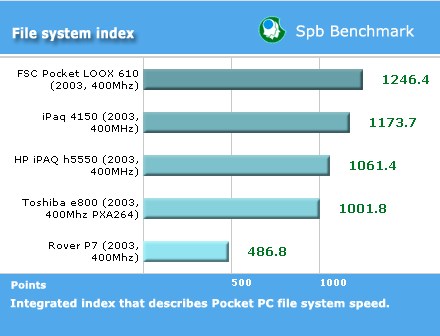
The file system index describes Pocket Pc file system speed (read/record/move). As you see, Rover P7 has failed here, the leader left it far behind. As a matter of fact, in a real situation you notice the system to drag, but that’s not that critical as the test suggests. Though you see it with the naked eye it doesn’t disturb the normal work. You can get used to it.
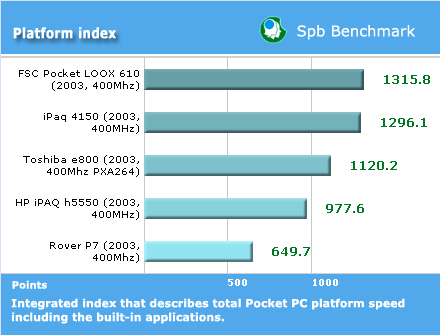
The platform index describes total Pocket PC platform speed including the built-in applications. This is anther failure for the P7. The result however is predictable, as it depends mostly on the file system speed.
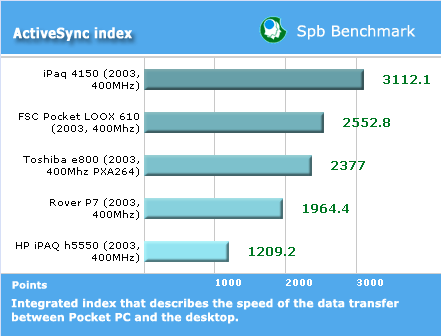
The synchronization speed stays average, nothing special.
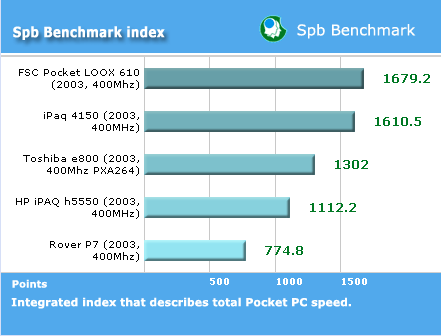
Integrated Spb Benchmark index describes total Pocket PC speed. The P7 displayed poor results, the lowest among handhelds equipped with Wi-Fi. But I do repeat slow speeds aren’t that evident. Test results do not access the everyday work.
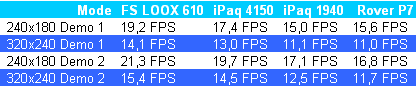
In conclusion see the table below. We ran tests of the PocketQuake game in the mute mode (turn the sound off by nosound 1 console command) leaving other settings on:
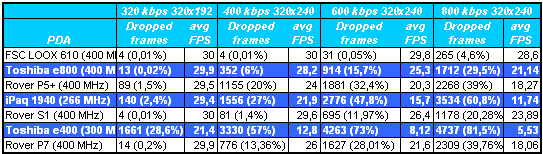
In the video mode we tested several clips at different intensity (kbps – kilobit per second, DivX 5.03 codec involved). Sound got encoded in mp3 format with 128kbps bitrate. We applied the criteria of dropped frames while playing, the less the better and tested a fragment from the motion picture Cats and Dogs (the fight scene). See the results:
Interface
The handheld is stuffed with interfaces at the maximum extent: both wire and wireless. Let’s start with wire interfaces. The miniUSB (host) is placed at the bottom. It helps plug different devices to the handheld. For example, external drives, flash reader, keypad, mouse and other gadgets (a friend of mine copied for me the soundtrack to the motion picture Kill Bill using his Apple iPod player). However, don’t be sure that any device equipped with the USB interface could communicate with the handheld, the main issue here concerns the availability of proper drivers. The connector for the cradle and synchronization cable is the same as for the iPaq series (all recent models). And it’s the good news; there are enough cables for iPaq models, so it isn’t a problem to find the cable if needed. We shouldn’t omit two slots for extension – SD/MMC and CF. Both slots can be used to connect external devices, not only memory cards (SDIO function supported).
Despite great popularity of Bluetooth and Wi-Fi you shouldn’t forget about infrared, it is still among wireless connectivity means. Every handheld worth its salt has an IR port. The port supports the CIR standard (consumer infrared), i.e. it works as the remote control within 4 meters distance.
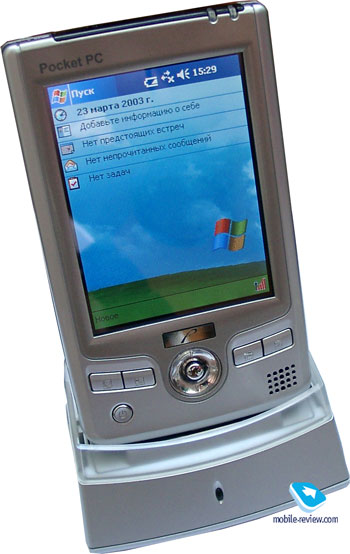
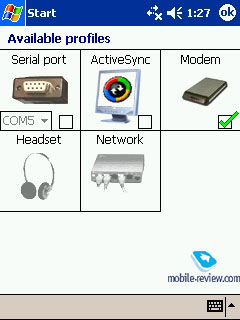
Wi-Fi&Bluetooth. Strange as it may seem these two words hide two main weak points as well as two strong points of the handheld. The fact that they are available, a rare one, stands for an advantage. However their implementation fails. Firstly, adapters do not support the simultaneous work (the continuous roaming between wireless networks gets broken as well as the simultaneous work of the Bluetooth-garniture and IP-phone software). Secondly, each of them gets started for dozens of minutes (the same for the switch and initialization at the launch). Thirdly, as for the software there are no Bluetooth or Wi-Fi managers, so respective settings look poor enough. Bluetooth lacks the Bluetooth serial port profile (for DPA synchronization and SMS messaging via Bluetooth) and Bluetooth FTP. MiTAC saved on license fees and refused using external applications to manage wireless connectivity, it just involved Windows Mobile 2003 integrated managers. Partially the problem can be solved by installing a freeware XDA O2 BT-manager (note, a man from MiTAC had a hand in the development process) and an external scanner for Wi-Fi networks (we used PocketWinC). In the result the P7 yields to the iPaq4150 in the wireless functioning (the simultaneous adapter work, instant start, Bluetooth manager and Wi-Fi scanner). On the other side it is at the same level as the FSC Pocket LOOX 610 featuring very poor simultaneous work, long start, but the own Bluetooth manager is available. From the maker’s site you can download the driver, which transforms the PDA connected to the PC into Wi-Fi USB adapter to enable wireless networking with the PC or notebook. No doubt, the handheld loses its advantages due to a poor wireless connectivity, but that’s not a critical factor. It’s easy to get used to the peculiar work of the adapters, especially if we remember it’s the first device with such interface set.
Software
The handheld is powered by Windows Mobile 2003 for Pocket PC Premium Edition. You can learn more about standard software included reading the related review published on our site. All built-in applications got fully russified by Quarta Technologies and set into the permanent memory of the device. After the hard reset you may chose between interface languages – Russian or English. Some additional applications include the following:
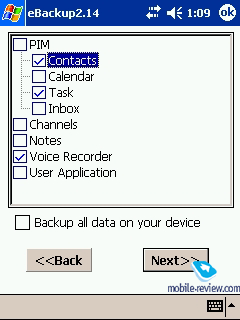
eBackup. A simple utility to back up data. It implements only main functions and hs poor settings (for example, you cannot schedule the backup).
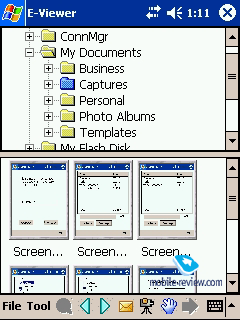 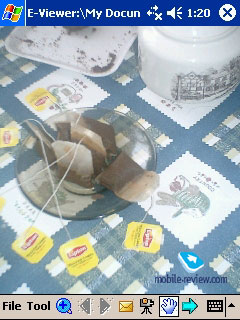
E-Viewer views graphic images, scales them and runs photo presentations.
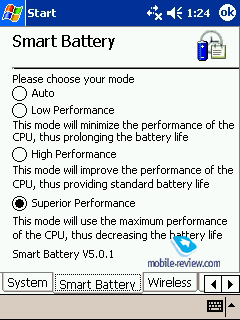 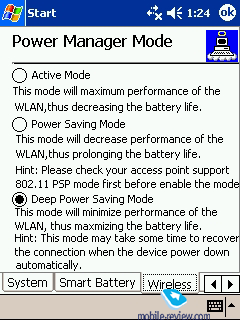
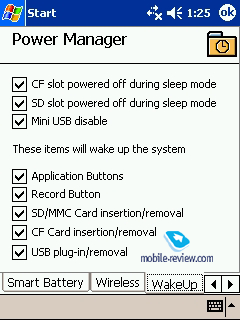 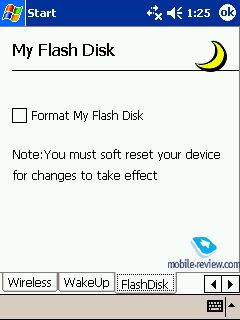
Additional PDA settings include extended power manager: sets CPU speed, power consumption when using Wi-Fi and other interfaces.
Conclusion
Despite of some shortcomings (speed, wireless adapters functioning) the handheld proves a good buy for those looking for maximum functionality at reasonable prices ($450 at the moment). This model competes with HP iPaq 4150 and FSC Pocket LOOX 610. iPaq 4150 lacks a CF slot, but wireless adapters function better. And Pocket LOOX wins with the system speed rate, a useful feature for a certain users group. If you don’t extremely need an integrated Wi-Fi adapter take a better look at the HP iPaq 2210 and ASUS A620BT.
General features
- Class: wireless business model
- Rival models: FS Pocket LOOX 610, HP iPaq 4150, HP iPaq 5550
- Operating system: Windows Mobile 2003 Premium Edition
- Processor: Intel XScale PXA263 400 MHz
- Memory: 64 MB RAM (63.30 MB available to the user)
- ROM: 64 MB (31.15 MB available to the user)
- Connectivity: SD/MMC slot, CompactFlash slot, IrDA (CIR, 4 meter distance), USB host at the casing, Bluetooth, Wi-Fi.
- Display: 3,5” (active screen: 53x71 mm), 240x320 pixels, 64K colors
- Battery: Li-Ion 1200 mAh
- Dimensions: 124x72x15 mm
- Weight: 170 grams.
Anton Kotov
(anton.kotov@mobile-review.com)
Translated by Anja Rytchkova (anja.rytchkova@mobile-review.com)
Published (Russian) – 19 February 2004
Published (English) – 1 October 2004
Have something to add?! Write us... eldar@mobile-review.com
|
News:
[ 31-07 16:21 ]Sir Jony Ive: Apple Isn't In It For The Money
[ 31-07 13:34 ]Video: Nokia Designer Interviews
[ 31-07 13:10 ]RIM To Layoff 3,000 More Employees
[ 30-07 20:59 ]Video: iPhone 5 Housing Shown Off
[ 30-07 19:12 ]Android Fortunes Decline In U.S.
[ 25-07 16:18 ]Why Apple Is Suing Samsung?
[ 25-07 15:53 ]A Few Choice Quotes About Apple ... By Samsung
[ 23-07 20:25 ]Russian iOS Hacker Calls It A Day
[ 23-07 17:40 ]Video: It's Still Not Out, But Galaxy Note 10.1 Gets An Ad
[ 19-07 19:10 ]Another Loss For Nokia: $1 Billion Down In Q2
[ 19-07 17:22 ]British Judge Orders Apple To Run Ads Saying Samsung Did Not Copy Them
[ 19-07 16:57 ]iPhone 5 To Feature Nano-SIM Cards
[ 18-07 14:20 ]What The iPad Could Have Looked Like ...
[ 18-07 13:25 ]App Store Hack Is Still Going Strong Despite Apple's Best Efforts
[ 13-07 12:34 ]Infographic: The (Hypothetical) Sale Of RIM
[ 13-07 11:10 ]Video: iPhone Hacker Makes In-App Purchases Free
[ 12-07 19:50 ]iPhone 5 Images Leak Again
[ 12-07 17:51 ]Android Takes 50%+ Of U.S. And Europe
[ 11-07 16:02 ]Apple Involved In 60% Of Patent Suits
[ 11-07 13:14 ]Video: Kindle Fire Gets A Jelly Bean
Subscribe
|

 Samsung Galaxy Note. First Look
