Review GSM communicator Motorola The MPx
Standard kit:
- Smartphone
- Charger
- USB cable for synchronization
- Extra stylus
- Case
- Wire stereo headset
- Manual
- CD with software
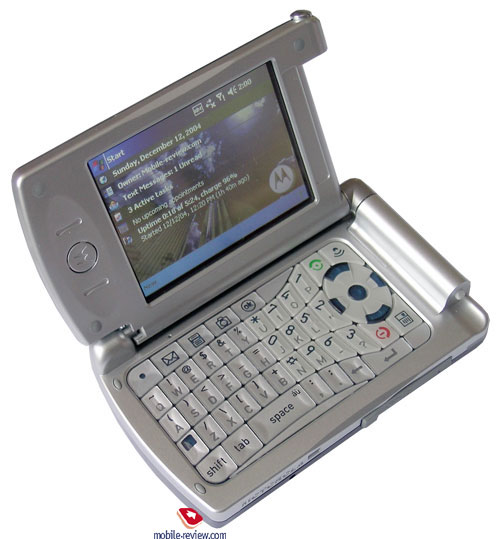
Motorola MPx. Live pictures
Motorola produces smartphones using Windows versions certified by ODM-contracts with Thai manufacturers (Chi Mei and Compal companies). After the success of Motorola MPx200 model, three other models-Motorola MPx220, MPx100, and just Motorola MPx, first Motorola model based on Pocket PC platform, (see further in the review) were planned for the year 2004. It was only MPx220 model that made it to the market (as a booming follow up of the blockbuster model). The review can be found here. The remaining models attained little recognition. The outcome of cooperation between Thai ODM and Motorola manufacturers is to be regarded at the end of the review.
The MPx has always been on the most permanent models on the smartphones/communicators market. The first leakage of information (the pictures of penultimate design version, some specifications) happened in the second half of year 2003. The model was officially announced in February 2004 in Cannes (almost one year ago) during the 3GSM congress. The model was anticipated on the sales in the second half of 2004 but this never happened.
The active development of the device began in the first half of the year 2003, when the company Texas Instruments represented a revolutionary (for that moment of time) WANDA platform-Wireless Any Network Digital Assistant (Bluetooth, Wi-Fi, GSM/GPRS-all in one, which was then considered an astonishing feature).
A lot of changes occurred during the model's progression from the first conceptual drafts and up to the finalized product. The observation of the process was quite interesting. The communicators/smartphones are now no more than the experimental fields and only few companies (such as Nokia, Sony Ericsson, HTC) that stand out for the well-functioning mechanisms and the products recognition on the market.
First, the name changed. It was initially planned for the product to enter the market under the name of Motorola MPx300, which was changed in favor of Motorola MPx. The product was also known in the network under the false name of MPx300-the model was never called that. Second, the design was changed for at least four times (the location of the camera and the keypad have undergone the major changes). On the first models a straight keypad, and a camera located above the main display was observed. The final product, while preserving the mechanism of double opening as its key feature, has considerably changed: the camera was moved to the outward panel, and the keypad became that of wavy curves. The inner mechanism was also modified from the outward display to the inbuilt camera. Unfortunately, the memory capacity was not extended in the final product.
Dual-hinge or the Unique Mechanism
If just a couple of years ago, we could talk of only two form-factors (mono-block and clamshell), now it is possible to compose a list of the existing form-factors or those that will emerge in the nearest future (this list avoids the strict distinction between smartphones and phones since it is not of primary importance for the matter).
- CandyBar - is a classical mono-block without any moving parts. Lately, a fashionable variation of this form-factor became popular (Pen Phone-Nokia 7280, Haier P6). This design is also found in horizontal alternative (for ex. Nokia N-Gage).
- Clamshell - this very classical model can be found in two form-factor variations-vertical and horizontal (Nokia 9500) one.
- Slider - this form-factor stands for a frame-case made of two parts moving in one direction along one line. Lately this design became popular (Samsung E800, Samsung D500, Siemens SL65). An 'upward-shooting' upper part of Nokia 8910 is one of the variations of this form-factor.
- Rotator - is a rotating opening mechanism (Motorola v80, Sony Ericsson s700i). Similarly to the 'slider', the two parts of the frame-case move in one plane (although it would be more fair to say 'in two planes'). The upper part rotates around one point (which can be called a rotating point). X or Ross are the other variations of this design and are basically the same with the only difference that the rotating point is found on the middle of one of the two parts of the frame-case (Siemens SK65, Samsung zl30) and the rotating angle makes 90 degrees instead of 180.
It might seem that all possible options for joining the two parts were exploited and it is impossible to come up with something very original. However, the developers went on combining different form-factors-the process that we are literally observing right now:
- Clamshell-Rotator - provides more room for the rotation of the internal display (Samsung Magic, Samsung p730).
- Slider-clamshell - has a double opening mechanism, which strikes one as unreal but will be soon represented in a Sony Ericsson model.
- Dual-hinge - is an extraordinary opening mechanism of Motorola MPx model. This mechanism combines both vertical and horizontal form-factor variations of a clamshell. The device is of two modes. In the phone mode, the device is no more than a considerably big clamshell. Switched to communicator mode, Motorola MPx is a folding communicator, like those produced by Nokia, with a keypad. It is worth seeing how such mechanism is operated.
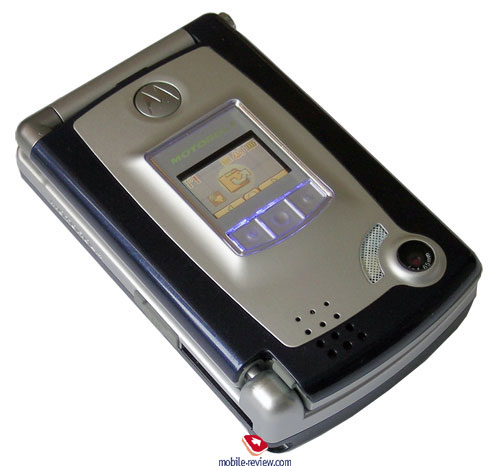
The reaction of people who tested this device is truly notable. While closed, the model does not draw your attention and it is true for one of the opened-up modes. However, it just takes to demonstrate how MPx can be opened in two different ways and you will see astonished looks and hear endless questions about the functioning of the mechanism. In the phone mode, the model can be opened like any regular clamshell-with one hand. It will take a slight effort to shift the frame-case in your hand, which is not very convenient due to the size.

In order to open the phone in the communicator mode, one has to push a button on the butt-end thus unlocking the display. After a little practice, it will take no more than two to three seconds to switch from one mode to another and just the same amount of time to change the OS interface. Overall, there should be no problems with opening the device. All the cords connecting the two parts of the frame-case are channeled through one hinge clearly made of metal.
Design, Assembling Quality, and Practical Convenience
The MPx design is distinguished for its form-factor, which will remain original and unique for a long time. In many cases, the design will actually become the prevailing factor of the purchase. The disadvantages of the dual-hinge mechanism are found in the outward look of the phone. For instance, during the conversation (the phone mode), a little corner of the upper part seems to be non-existent (the lashing place in the communicator mode), which does not look esthetically right. In addition to that, there is a little rising in the communicator mode. The bottom line is: which is original is not necessarily ideal.

The frame-case is made of plastic of very high quality the feel and color of which remind you of Toshiba e800 (that is not surprising since the manufacturer is the same). There is no deception about the material of the frame-case since plastic does not maintain an illusion of metal. The quality of the material can be evaluated as the 'good' one. Two metal parts-the previously mentioned hinge on the meeting-point of the two frame-case parts and the edging around the outward display are found on the frame-case. In either one of the modes there is no distinct fixed position of the two parts-they just open up to the maximum.
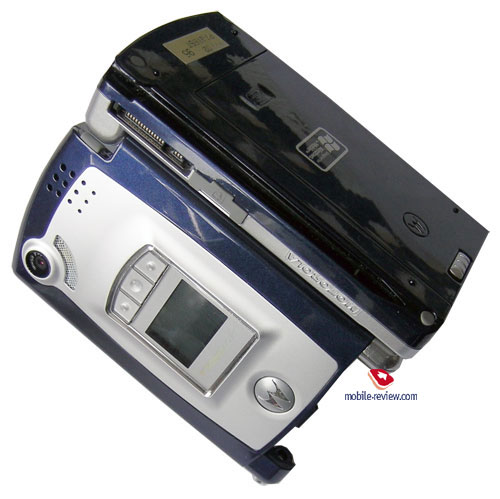
The parts have both vertical and horizontal lashes and if one squeezes MPx while it is closed, it will become obvious that the hinge is not very safe. It might be a fair price to pay for only one hinge joining both parts. All together, the quality of the frame-case materials is traditional for the Compal products (speaking of PDA) while lash is the outcome of the specific design.
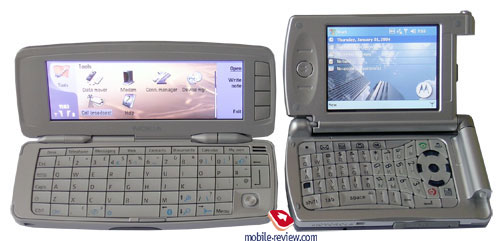
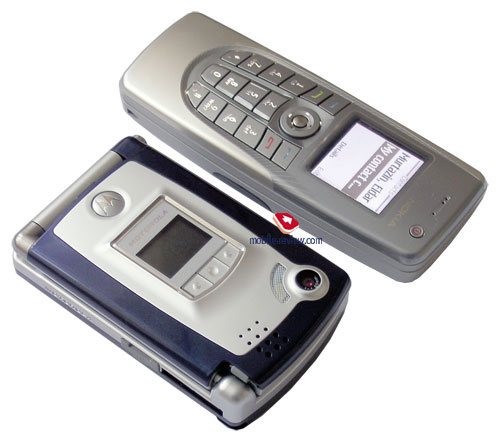
The dimensions of MPx are difficult to judge since it depends on what it is compared to and in which modes. While closed, the dimensions of the device are not big if judged against PDA or other smartphones. The weight of the device slightly exceeds the expectations.
- Qtek s100: 108x58x18.1mm 150 g
- Motorola MPx: 99.1x61.2x24mm 174 g
- Nokia 7610: 108.6x53x18.7 mm 118 g
- SE p900: 115x57x24 mm 150 g
- Asus p505: 108x60x22.5 mm 160 g
- Eten p300: 117x6x23 mm 165 g
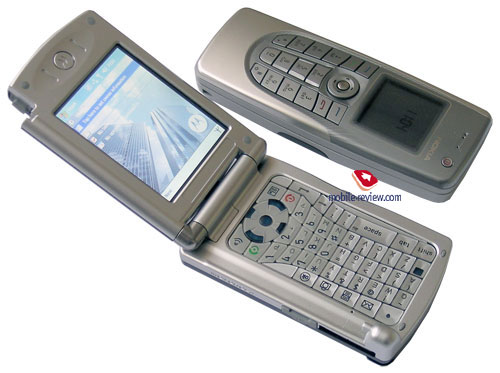
When MPx is opened as a phone, it looks like a clamshell of a considerably big size. It might be smaller than Rover S2, but it is still bigger than regular clamshell phones. However, this problem can be easily resolved with conducted-through or Bluetooth headset.
While in communicator mode, the size of the device does not come into notice. In the communicator mode, MPx can be compared to Nokia 9300 (smaller width is compensated by bigger length).
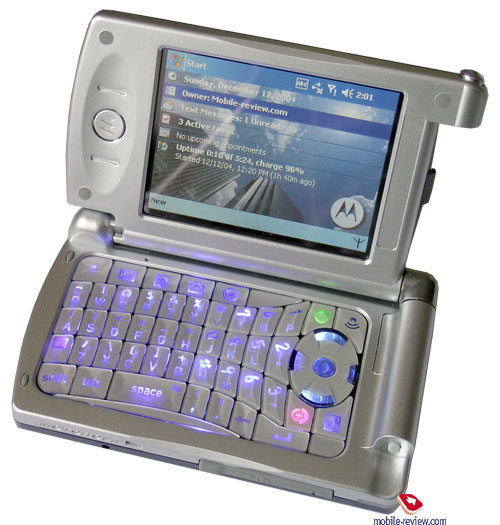
The developers were quite concerned with convenience of keypad for both modes of the phone and communicator. This is how the original curves along with the joystick and numbers written in the 45 degrees angle appeared. The alphanumerical part of the keypad is of slightly different color. The upper row of the keys is the buttons of speedy applications call as well as buttons for OK and Start commands. The register is switched using the blue key.
The keys are located closely to each other; are easy to operate and give a respond to a command. Speaking of relative keypad convenience (the working convenience), it is fair to admit that it is better than that of Palm Treo 600, HTC Blue Angel, but worse than that of Nokia 9300 due the keys size. The backlight of keypad is great and the signs are distinguished under any lighting conditions. The location of the keypad is not to be commented on here for the reasons revealed at the end.

An overlook of the elements available to the user when the frame-case is closed.
The IrDA is located on the upper butt-end (SIR), a 2.5 mm stereo connector for the headset.
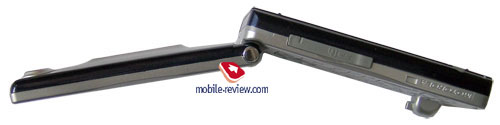
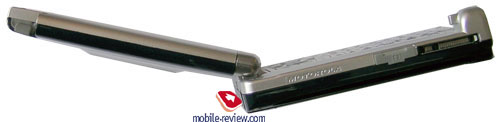
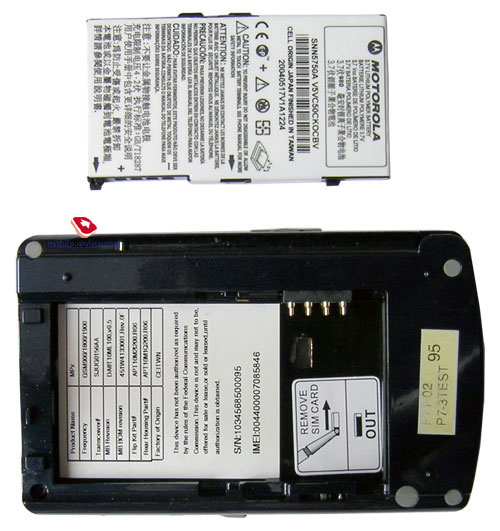
On the left side, the SIM-card connector blocked with the rubber muffler is found. It is a typical Motorola connector for the cable and battery synchronization (a standard cable can be used here). If the SIM-card is slid in while communicator is on, MPx will be automatically restarted. To take the SIM-card out, the battery will have to be removed as well in order to reach for the card located under the battery. Apart from the silo, nothing is located on the lower butt-end. Stylus of average size is very handy although it is easy to loose (on two of the four scrutinized devices, the stylus was missing).
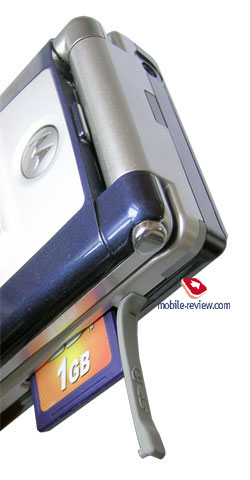
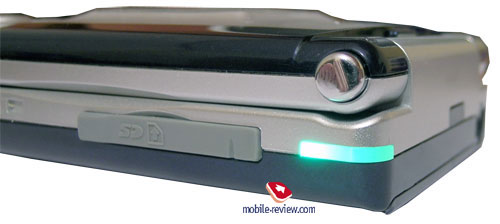
On the right butt-end, the SM/MMC slot covered with the rubber muffler is found. On the backside there is nothing but a battery compartment.
Battery
Li-Ion MPx battery is of 980 mAh capacity. There are no advantages or disadvantages to be mentioned about the battery life - everything is of the expected quality.
Used for calls as PDA one hour per day and for half-hour in the talking mode, the communicator worked for approximately two days. In the electric phone book mode (with the minimal backlight usage and the phone part switched on), the smartphone worked for ten hours. The maximum working time is three hours forty-five minutes. MPx sustained working in the MP3 player mode for exactly seven hours. All together, the results are very decent.
External Display
According to the fashion standards, the outward display of MPx is colorful although it used black and white in the early development phases. The screen of the STN technology is of 96x64 pixels resolution. The image quality gives an impression of the good 256-colors display. When exposed to the sun, the information on the display becomes barely readable.
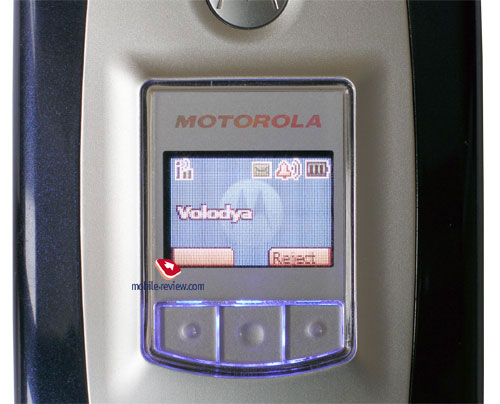
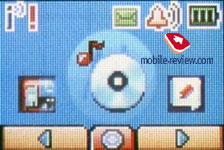
The screen displays the general information: battery charge, signal level, read/unread messages, date, incoming calls, and time in the stand-by mode. On the whole, all basic functions of the outward display are presented.
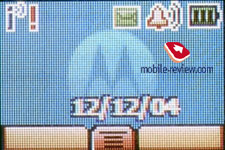

 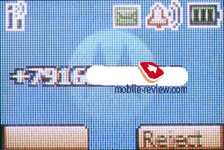
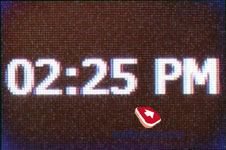
Three keys that extend the functional capacities of the outward display are found under the monitor. They allow a user:
 
- to change the profile;
 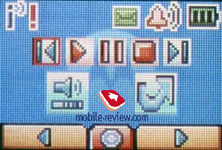
- to adjust the music level although only in the standard player with standard functions. Among the disadvantages, the inability to display the information about the playing composition (title, playing time, be-trait) should be mentioned. The settings are not available either as well as forwarding within the track.
 
- to use the type recorder and listen to the recorded files;
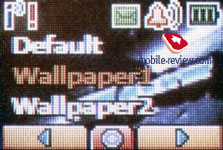 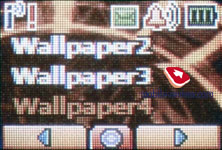
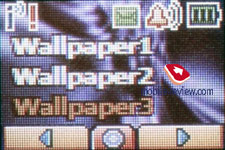 
- to changed the wallpaper of the external display;
 
- to choose the melody of the incoming call;
This information summarizes all that can be said about the outward display whose potential was only partially utilized.
Internal Display
The characteristics and the image quality of this display are typical for the Pocket PC of middle and low-end products-this is a trans-reflective TFT matrix of 320x240 pixels resolution capable of reflecting up to 65 thousand colors. Due to the minimal size of the frame-case, the display diagonal was also diminished to 2.8'' instead of 3.5''. The diminished size of the display diagonal (from 3.5'' to 2.8-3'') was recognized for a common tendency among the smartphones based on Pocket PC platform. When comparing the quality of the display to the other Pocket PC smartphones, it can be said that MPx display gives way to the HTC Magician, and Asus p505 display while overriding that of Eten p300 and being of the same class with Rover S2. The main disadvantage of the display is the overwhelmingly bright minimal level of backlight and mediocre view angles.
The monitor rotates automatically when switching from one mode to the next.
Camera
In the lower right corner of the outer part of the frame-case, the camera lens is found next to the flash (which is typically not very useful and works for short distances only). The maximum resolution of camera shots is 1280x960 pixels; there is not inbuilt video recording. Functionally, the camera is a bit better than an average one since a number of various settings is available.
Available resolutions:
- 1280x960
- 640x480
- 320x240
- 176x144
- 160x120
- 128x96
The camera was changed (prior to that change, the shots were even worse that those of Motorola MPx220) before the device entered the market. The Mobile group had a chance to test both, an old and a new one, models. The new model turned out to be strikingly better. The quality of the pictures is decent, slightly better than the average. The picture samples in comparison to the shots made with other inbuilt cameras can be found here.
Bluetooth and Wi-Fi
MPx is one of the first communicators (along with HTC Blue angel and Nokia 9500) that offer, apart from GSM/GPRS and Bluetooth, the cable-free Wi-Fi module. In the case of our group, Wi-Fi started working in MPx in the last moment. There is nothing specific to be mentioned about Wi-Fi since everything went the way it should have gone.
The Bluetooth version is 1.1 in the device. Unfortunately, MPx lacks already standardized WIDCOMM (now Broadcom) drivers, and instead the built-into the operating system Windows Mobile are used.
The test results of Bluetooth application to MPx are presented below:
- The synchronization through ActiveSync did not cause any problems and nor required any supplementary settings. The one Mb file recording took approximately 15 seconds. Synchronization takes very little time. If MPx is connected through ActiveSync, internet can be easily accessed through desktop computer.
- Dial-Up (Internet access through MPx). The connection through PC and PDA did not cause any problems.
- Files uploading. Files can be downloaded into the standard My Documens Folder only and this cannot be reset. The files cannot be downloaded through communicator.
- Contacts. The process is similar; the contact cannot be downloaded from MPx.
- Voice profile, and the headset. The sound is transmitted both in the talking mode and while the device is working, for example, when the player is on.
Specifications
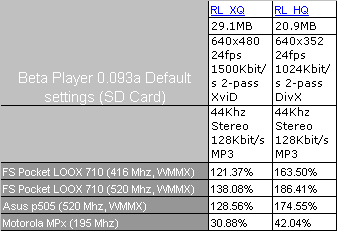
The central MPx processor is a Texas Instruments OMAP 733 of maximum 195 Hz. The processor can function with most of applications (mail, calendar, and other basic function of communicator). The processor gives way to the older Intel processors when it comes to videos and games. The test results of Beta Player are presented below as an example:
The operating memory capacity is 24.17 MB. However, the use can utilize 12.20 MB only! The operating system takes a part of the memory; another part is reserved for the offered programs. This is the biggest disadvantage of MPx. Several programs would not download. Due to the memory limits two of the three functions tests failed. It is highly recommended not to download anything into the operating system and Flash should be used instead. Because of the miniscule operating memory capacity, MPx cannot be fairly called Pocket PC. True, inbuilt programs function without errors, and the processor is sufficient to fulfill most of the requirements. However, as soon as one attempts to download and use outside programs, the small operating memory capacity will create a considerable problem.
Flash memory is of relatively small memory capacity-15.95 MB.
Software
Motorola MPx functions with WM2003 for Pocket PC Phone Edition, which is the same Windows Mobile 2003 for Pocket PC Second Edition (that you can learn about more in the respective review) although with several applications for the phone part added to it. There are a few remarkable programs to be mentioned.
DataBackup is a utility for reserved copying. DataBackup takes care of basic functions only; there are no special settings to be mentioned.
FreeMem. The MPx developers attempted to fight the little RAM capacity with program settings. This utility closes up the application to clean the memory.
Media Center operates the content protected by the copyrights.
Photo Album is used to view digital pictures.
Speech Recognition. This program for voice recognition similar to the one of Motorola MPx220 turned out to function well and be very convenient is use.
Impressions and Conclusions
With Motorola MPx there are no reception problems. The opponent is always well heard and it can be even said that the maximum volume is too high. The volume of the external loudspeaker is not sufficient all the time and the call might be missed in a noisy area. The vibrator force is decent.
For the first time, dual-hinge form-factor was applied to the model. It is partially a reason why the device was in the center of attention since it was first mentioned. The assembly quality high and the rising is an inevitable outcome of the design. Although the keypad is handy, it gives way to Nokia 9300 due to the button size. The little capacity of the available operating memory strongly limits the communicator capabilities.
Overall, the model is unique and even innovative. To see more communicators' models as the market grows is a pleasant sight. However, not all expectations become fulfilled.
As it was mentioned at the beginning, in the second half of the year 2004, Motorola was planning to offer to the market three models of the MPx series: MPx220, MPx10, The MPx. First, Motorola MPx100 was cancelled, while the emergence of other models was kept unclear. Finally, MPx220 entered the market (with limited shipments to a few regions). In December 2004, MPx was making the Compal 'stock' for already three months. According to the obtained information, a decision to call Motorola MPx product from the market was taken b the company. Beginning in February 2005 the stock savings only will be put on sale. It is clear, that no official shipments to Russia are planned for MPx. As it was recently uncovered, Motorola is moving the Windows-smartphones production from Thai market to its own manufacture reserves. Consequently, what will become of Motorola MPx 2 and Motorola MPx230 in the year 2005 remains a mystery.
Special thanks to Vobis.ru for the products generously offered for testing.
Description:
- Class: Pocket PC communicator
- Position in the line: starts
- OS: Windows Mobile 2003 for Pocket PC SE Phone Edition
- Processor : TI OMAP 733 195 MHz
- RAM: 32 MB (27.17 MB available to a user)
- Flash : 15. 95 MB available to a user
- Interfaces: SD / MMC connector with SDIO , IrDA , Bluetooth 1.1, Wi - Fi support
- GSM 900/1800/1900 GPRS class B
- Screen: TFT 2.8” with the resolution of 240x320 pixels, showing 65K colours
- Extrenal screen: STN with the resolution of 96x64 pixels
- Camera: 1.3 megapixel, flash, not recording video
- Integrated QWERTY-keypad
- Battery: removable Li - Ion capacious of 980 mAh
- Dimensions: 99.1 x 61.2 x 24 mm
- Weight: 174 g
Anton Kotov (anton.kotov@mobile-review.com)
Translated by Maria Sennikova (maria@mobile-review.com)
Published — 7 March 2005
Have something to add?! Write us... eldar@mobile-review.com
|

 Samsung Galaxy Note. First Look
